Jared Chavez (Creature Artist) Youtube Page
https://www.youtube.com/@jchave7/videos
Interview Best Practices
Games & Entertainment Industry
Preparing for an interview in games or entertainment
requires more than talent — it requires preparation, professionalism, and
industry awareness.
Craft Your Introduction
Have a strong “Tell me about yourself” ready.
Research the Company
Walk in informed.
Understand the Role
Be ready to explain why you fit.
Be Ready for Industry-Specific Questions
Studios want to know how you work, not just what you make.
Practice Before the Interview
Preparation builds confidence.
Close the Interview Strong
Always end with thoughtful questions.
Examples:
Thank them for their time and express genuine enthusiasm.
Final Reminder:
Talent gets you considered.
Preparation gets you hired.
Artist,
Here is an example of How to Professionally show off your 3D models in the various stages.
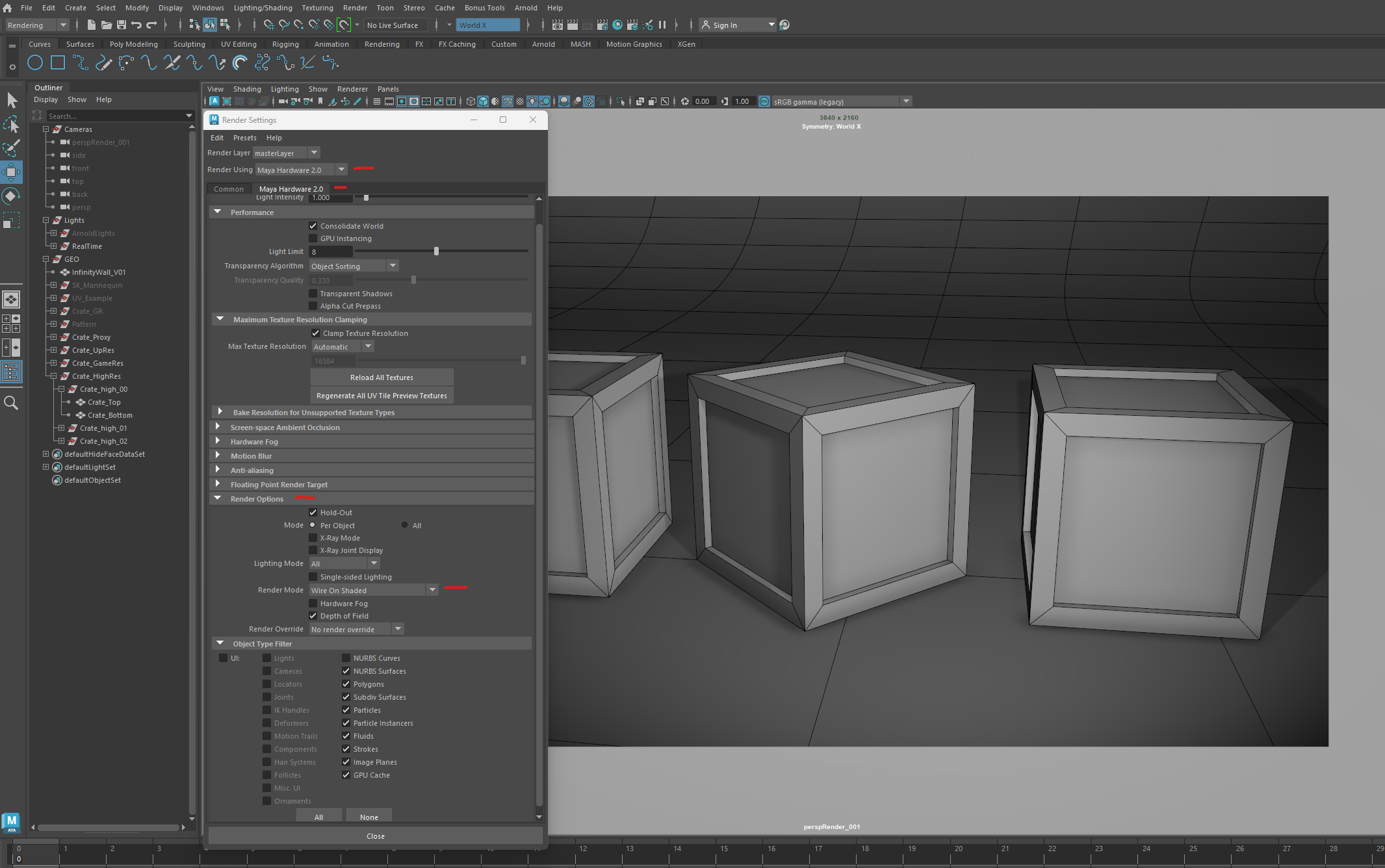
The first stage is your Proxy Mesh. (Showing off both the grey rendered version of the model along with the wireframes for the objects.)
Note - The following shots have been rendered in Maya Arnold. For the grey render I used an aiStandardSurface. I plugged in an aiAmbientOcclusion node into various slots on the material.
For the wire frames, I rendered with aiWireframe material, the infinity wall was filled with an aiAmbientMatte, I then took an aiAmbeintOcclusion node and fed that into the color of both of these materials.
Here are the results of theses shaders.


Disney Villains – What makes a great villain? Explore how something so evil can hold so much appeal.
Sculpting Wood – From stylized to hyper-realistic approaches.
Sculpting Stone – Capturing weight, texture, and style.
Portrait Sculpture – Bringing life and personality to faces in three dimensions.
Anatomy Exercises – Focused studies on torso, arms, legs, and full-body forms.
Posing for Characters – Dynamic posing techniques, from brute-force adjustments to Character Creator workflows.
Substance Painter: Organic Skin – Painting lifelike skin tones and surface detail.
Substance Painter: Metal – Creating believable and stylized metallic surfaces.
Substance Painter: Wood – From weathered planks to polished finishes.
Substance Painter: Plastics – Realistic and stylized polymer materials.
Substance Painter: Hand-Painted Workflows – Painterly textures with digital precision.
Unreal Advanced Material Techniques – Building complex, performance-friendly materials.
Clothing with Marvelous Designer – Designing and simulating garments.
Hair with X-Gen – Creating believable hair and fur.
Blueprints: Character Motion & Life – Adding animation and interactivity to characters.
Blueprints: Weapons & Items Motion & Life – Functionality and responsiveness for props.
Blueprints: Environment Motion & Life – Bringing worlds to life through movement and effects.
For this exercise, we will focus on story.
Story can take many forms — from a brief history or backstory of a character, item, or place, to a full-scale narrative following a character’s journey through the classic Hero’s Journey structure.
Our goal for this team-building assignment is to work collaboratively across three distinct disciplines — Art, Design, and Programming — to create a small but compelling story world.
This story world should be rich enough to serve as the foundation for a potential game environment, providing a narrative framework that could support characters, gameplay mechanics, and environmental design.
For this team-building exercise, we will create small but compelling story worlds inspired by the top 10 empires in history.
Each team will work collaboratively across Art, Design, and Programming to research, imagine, and present a unique world based on their assigned empire.
(See End Of Post For Detailed Description)
Akkadian Empire
Egyptian New Kingdom
Achaemenid (Persian) Empire
Macedonian Empire (Alexander the Great)
Roman Empire
Gupta Empire
Islamic Caliphate (Umayyad & Abbasid)
Mongol Empire
Spanish Empire
British Empire
Each team will be made up of three disciplines:
Colors, patterns, and symbolic imagery
Clothing styles, armor, weapons, and vehicles
Architecture, monuments, and decorative motifs
Government and leadership systems
Laws, customs, and social order
Manufacturing hierarchy and economy
Tools, machines, and infrastructure
Military technologies and communication methods
Unique technological advantages over other empires
Your team may embellish and reimagine historical details to make your story world more exciting, fantastical, or game-like.
However, there is a clear limit:
If the alterations make the empire no longer recognizable — removing its core identity, culture, or defining traits — you have gone too far.
The goal is to create a stylized evolution of your empire, not to erase its essence.
While each discipline will have a focused research area, all disciplines must collaborate to ensure visuals, narrative, and concepts are unified.
The final product will be a 5-minute PowerPoint presentation delivered to the entire cohort.
This is not just a class project — treat it as if you are pitching your concept to company executives for potential greenlight approval.
Your slides, visuals, and speaking style should be professional, cohesive, and persuasive.
Think of this as a healthy competition between creative departments in a larger corporation, each vying for approval of their concept.
The clarity, polish, and professionalism of your pitch will directly influence how it is received.
No large blocks of text without supporting imagery
Every slide must be a compelling piece of visual storytelling
Found imagery is required; AI-generated imagery must also be incorporated into all slides
Collaging is encouraged — you may mix AI-generated imagery, found references, and your own painted-over elements
You must incorporate sound into your presentation:
A themed soundtrack should play in the background (adjust volume so the speaker is audible)
A few impactful sound effects should be added to grab attention
Title Screen: A decorative font that represents your empire
Headers: A semi-decorative font that complements the title font
Body Text: A clean, readable font for descriptions
All visual elements should reflect the time period, culture, and tone of your assigned empire
Art must support the concepts discussed by other disciplines in your team
By the presentation day, each team must have:
5-minute PowerPoint with a unified visual style
Slides that visually and thematically support all spoken content
AI + Found Image Collages on every slide, with optional painted-over elements
Clear representation of the empire’s art, society, and technology
Recognizable connection to the original historical empire, even with creative embellishments
This project is not just about history — it’s about transforming historical facts into an immersive story world that could serve as the framework for a game environment.
Research thoroughly, think creatively, and collaborate effectively so that your empire’s world comes alive.
All students will watch every presentation.
After all teams have presented, each student will rank the teams from 1 (best) to 10 (least effective) based on:
Professionalism of the pitch
Creativity and originality of the story world
Accuracy and recognizability of the historical influence
Visual quality and cohesion of the presentation
Rankings & Points:
1st Place: 100 points
2nd Place: 98 points
3rd Place: 96 points
4th Place: 94 points
5th Place: 92 points
6th Place: 90 points
7th Place: 88 points
8th Place: 86 points
9th Place: 84 points
10th Place: 80 points
1. Akkadian Empire
Time period: c. 2334–2154 BCE
Region: Mesopotamia (modern Iraq and Syria)
Description: First known empire in history, founded by Sargon of Akkad, uniting city-states under a central ruler
Technologies: Bronze tools/weapons, cuneiform writing, irrigation systems, standardized weights and measures
Goods produced: Grain, textiles (wool), beer, pottery
Art: Cylinder seals, monumental stone stelae, realistic bronze and stone sculpture
2. Egyptian New Kingdom
Time period: c. 1550–1070 BCE
Region: Nile River Valley, Egypt
Description: Egypt’s imperial peak, with powerful pharaohs like Ramses II; dominated Nubia and Levant
Technologies: Advanced stone masonry, chariots, composite bows, papyrus-based record keeping
Goods produced: Gold, papyrus scrolls, linen textiles, glass
Art: Monumental temples, detailed wall paintings, elaborate tomb art (hieroglyphics + symbolism)
3. Achaemenid (Persian) Empire
Time period: c. 550–330 BCE
Region: From Anatolia to Indus Valley
Description: Largest empire of its time; tolerant governance; advanced administration
Technologies: Qanat irrigation, Royal Road postal system, standardized coinage
Goods produced: Spices, fine textiles, silver/gold crafts, agricultural products
Art: Relief carvings (Persepolis), intricate metalwork, monumental architecture
4. Macedonian Empire (Alexander the Great)
Time period: 336–323 BCE
Region: Greece to Egypt to India
Description: Spread of Hellenistic culture; short-lived but transformative
Technologies: Advanced siege warfare, phalanx military formation, Greek engineering
Goods produced: Olive oil, wine, marble sculptures, luxury goods traded across regions
Art: Hellenistic sculpture (emphasis on realism and motion), mosaics
5. Roman Empire
Time period: 27 BCE–476 CE (West), to 1453 CE (East/Byzantine)
Region: Mediterranean, Western Europe, Middle East, North Africa
Description: Unparalleled in infrastructure and law; influenced modern governance
Technologies: Concrete, aqueducts, advanced roads, domed architecture, bound codices
Goods produced: Wine, olive oil, glassware, ceramics, metal tools
Art: Mosaics, realistic portraiture, monumental buildings like the Colosseum and Pantheon
6. Gupta Empire
Time period: c. 320–550 CE
Region: Northern India
Description: Golden Age of India; advances in math, astronomy, and literature
Technologies: Decimal system, early metallurgy (iron pillars), surgical tools
Goods produced: Spices, silk, cotton textiles, carved ivory
Art: Buddhist and Hindu temple sculpture, Ajanta cave paintings
7. Islamic Caliphate (Umayyad & Abbasid)
Time period: 661–1258 CE (with later successor states)
Region: Middle East, North Africa, Spain, Central Asia
Description: Major center of science, trade, and culture; preserved Greek knowledge
Technologies: Astrolabe, algebra, advanced optics, windmills, paper manufacturing
Goods produced: Textiles, glass, ceramics, sugar, perfumes
Art: Geometric tilework, Arabic calligraphy, intricate metal inlay
8. Mongol Empire
Time period: 1206–1368 CE
Region: From China to Eastern Europe
Description: Largest contiguous land empire in history; promoted trade via Silk Road
Technologies: Composite bows, stirrups, courier relay system, siege engines
Goods produced: Silk, porcelain, horses, furs
Art: Silk embroidery, Persian-Mongol illustrated manuscripts, decorative weaponry
9. Spanish Empire
Time period: 1492–1898 CE
Region: Americas, Europe, Africa, Asia-Pacific
Description: First truly global empire; fueled by New World silver and gold
Technologies: Galleons, advanced cartography, printing press in colonies
Goods produced: Silver, sugar, tobacco, cacao, wool
Art: Baroque religious painting, colonial architecture blending European and indigenous styles
10. British Empire
Time period: 1583–1997 CE (height in 19th–early 20th century)
Region: Worldwide (largest empire in history by area)
Description: Economic and naval dominance; spread English language and institutions
Technologies: Steamships, railways, telegraph, industrial manufacturing
Goods produced: Manufactured goods, coal, textiles, tea, machinery
Art: Victorian architecture, Romantic literature, landscape painting
Prehistoric Art (c. 40,000 BCE – 4,000 BCE)
Cave paintings, petroglyphs, megaliths (e.g., Lascaux, Stonehenge).
Ancient Art (c. 4,000 BCE – 400 CE)
Egyptian, Mesopotamian, Greek, Roman; focused on mythology, gods, and human figures.
Byzantine Art (c. 330–1453)
Religious iconography, mosaics, gold backgrounds, Christian themes.
Islamic Art (from 7th century)
Calligraphy, geometric patterns, arabesques, non-figurative.
Romanesque (c. 1000–1150)
Thick walls, round arches, religious themes in sculpture and manuscript illumination.
Gothic (c. 1150–1400)
Stained glass, flying buttresses, more naturalistic figures.
Renaissance (c. 1400–1600)
Humanism, perspective, realism (Leonardo da Vinci, Michelangelo).
Mannerism (c. 1520–1600)
Elongated forms, exaggerated poses, complex compositions.
Baroque (c. 1600–1750)
Dramatic, emotional, use of light and shadow (Caravaggio, Rubens).
Rococo (c. 1720–1780)
Ornate, pastel colors, playful and romantic scenes.
Neoclassicism (c. 1750–1830)
Inspired by ancient Greece and Rome, clarity, symmetry (Jacques-Louis David).
Romanticism (c. 1800–1850)
Emotion, nature, individualism (Delacroix, Turner).
Realism (c. 1840–1880)
Everyday scenes, social issues (Courbet, Millet).
Impressionism (c. 1860–1890)
Light, color, visible brushstrokes (Monet, Renoir).
Post-Impressionism (c. 1880–1905)
Emotional expression, abstraction (Van Gogh, Cézanne, Gauguin).
Symbolism (late 19th century)
Dreams, mythology, imagination (Moreau, Redon).
Art Nouveau (c. 1890–1910)
Decorative arts, flowing lines, nature-inspired.
Fauvism (c. 1905–1910)
Bold color, simplified forms (Matisse).
Expressionism (c. 1905–1930)
Inner emotion over external reality (Munch, Kirchner).
Cubism (c. 1907–1914)
Geometric forms, multiple perspectives (Picasso, Braque).
Futurism (c. 1909–1944)
Speed, technology, movement (Boccioni).
Dada (c. 1916–1924)
Anti-art, absurdity (Duchamp).
Surrealism (c. 1924–1966)
Dreams, subconscious, automatism (DalÃ, Magritte).
Abstract Expressionism (c. 1940s–1950s)
Gestural abstraction (Pollock), color fields (Rothko).
Pop Art (c. 1950s–1970s)
Popular culture, mass media (Warhol, Lichtenstein).
Minimalism (c. 1960s–1970s)
Simplicity, geometric forms (Judd, Stella).
Conceptual Art (c. 1960s–)
Idea over object (Kosuth, Sol LeWitt).
Performance Art (1960s–)
Live actions (Marina Abramović).
Land Art (1960s–)
Art in nature (Robert Smithson).
Street Art / Graffiti (1980s–)
Urban, political, Banksy-style interventions.
Digital Art / New Media (1990s–present)
AI, virtual reality, interactive works.
Great tool for viewing the human figure.
I love to draw, paint, and sculpt. I have been drawing since I can remember holding a pencil. I have always been drawing/creating art. For some reason art and the creative process has always been a part of me and I have never really questioned that I wanted to do something of significance with my talents.
I have been very blessed to have worked as a professional artist for a very good part of my life, one of my first jobs was airbrushing t-shirts at Six Flags Over Mid America when I was about 16 years old. I worked for a magnet company for a period of time, that was my first introduction to working with computers to make art. I worked for a company installing vinyl graphics on cars/trucks and semi trucks. And then I landed my first job that was a bit closer to what I currently do, I was a 3D artist making graphics with designers to produce large format graphics for tradeshow events. During this time I knew I wanted to work in the video games industry and had to stay after work hours to teach myself Autodesk Maya when it first came out. I finally landed my fist video game art job when I was in my mid 20ies.
During my career in the games industry I had the opportunity to be part of Electronic Art's EAU (AE University) EAU was EA's internal training department and I was able to teach professionals how to use programs like Maya and ZBrush. Eventually funding for that department dried up and I returned to be a production artist, but the love of teaching never left me.
You see one of my most profound memories as a student was when I was in the first grade and my art teacher during that time encouraged me and told me I was a really good artist. It was the first time in a school setting that I could remember a teacher giving me praise for my abilities. Those teachers words still ring in my head to this day.
So when I had the opportunity to make a career shift and lave the games industry for a teaching positions with UCF's FIEA program I jumped at the chance.
Now I am in a position to still make the type of art I love, I'm still tied to the games industry, but above all else I get to pour into other peoples lives and help them achieve their dreams and goals.
I doubt that teacher in the first grade knew the huge impact her worlds would have over my life, I like to think maybe she did and that is exactly why she was there in that moment. But I am now trying to do my best to live with that type of intentionality as an artist, instructor and a teacher. I'm trying to try and have that type of impact on the people that have been entrusted in my life.
* How Many Pieces - By the time you leave FIEA you want to have 3-5 Super High Quality Portfolio pieces. (3 is the bare minimum)
* Quality Is King -You are only as strong as your weakest piece
* Strategy With FIEA Timeline -1st and 2nd semester should be used to learn your craft, learn the tools and process, learn how to work smarter not harder. Learn how to make various styles. Discover what specific type of 3D artist you want to become. (Character, Environment, Weapons/Props, Hard Surface, Vehicles/Ships)
* 1st and 2nd Semester -The assignments from 1st and 2nd Semester will not be enough for you, you need to be doing personal studies outside of class in order to round out your specific skill set for yourself. (Character artist need to be doing anatomical studies for example)
* 3Rd Semester - 3rd Semester you need to produce 3 High Quality Pieces of your choosing. ( I will work with you to pick the best choices for you)
* 4th Semester - 4th Semester you need to create at least 2 High Quality Portfolio Pieces and use the remainder of your time making corrections to your website and Portfolio pieces you have already created. If you do not get an internship, the worst thing you can do is sulk and coast that semester. If you coast during the 4th semester, you will most likely coast your way to a job at Starbucks.
If you do not land a job after leaving FIEA, you cannot give up. Some people it has taken them a year of grinding after FIEA to land their first job.
Do not thumb your nose at non game jobs if you cannot land a game job right off the bat, a job where you produce art of any kind will be better than having a job that has no art component to it.
* Choosing Designs for Portfolio - When choosing pieces to work on, Art Station and Pinterest are great places to find high quality professional concept art, to emulate the job for real world, recreate that concept to the best of your ability. If the concept has missing information (such as only a front view) your job as the artist is to fill in the missing detail while still maintaining the look and the feel of the provided design (such as creating the reminder of the design on the backside that is missing).
* Animators - Animation should be your primary skill set that you are showcasing. But I do feel that game animation is a bit different than film animation. In film you build animation for a locked down frame/camera shot. It's all about that one performance. As a game artist, it's more about interlocking animation clips that flow in and out of one another.
Become MoCap certified. I have seen over the years more job opportunities for the animators that have MoCap experience. At the very least know how to clean the data and show it off in a compelling way on your portfolio.
Be flexible, know how to make skeletons, know how to paint skin weights, know how to set up simple calisthenics animations to test your deformation and range of motion. Know how to set up simple FK and IK rigs. Know how to effectively communicate with the rigger to get the performance you are look for.
Know how state machines work, build your own state machines, demonstrate how your animation clips work together to build overall compelling animations that work in a real-time environment.
I feel above all other groups that Capstone is the playground for the animators to build high quality animations that can live on in their portfolios.
* Tech Artist - Team up with artist to get high quality models and animations for your reels. The quality factor of what you are showing off can have an impact on the non-tech artist that may be involved with reviewing your work.
Figure out compelling ways to show off your work to less technically minded people, your challenge is going to be taking complex subject matter and showing it off to more of a lay person that my not have all the technical know how to understand why your work is important.
Part of your job is to be a sales person, you need to sell your work almost as a product. Convince us why your work will save us time or money.
Websites - KISS. Keep It Simple (Soldier) Make it as EASY as possible for anyone to navigate your website and find your work.
Your work will be judged in a highly time sensitive environment, if you make people fumble around trying to view your work, they may just move on to the next person and just skip over you period.
Make sure to use compelling thumbnails for your work. Draw people in to want to look at your work.
Keep EVERYTHING as professional as possible.
Resume and contact information should be as simple as possible to find.